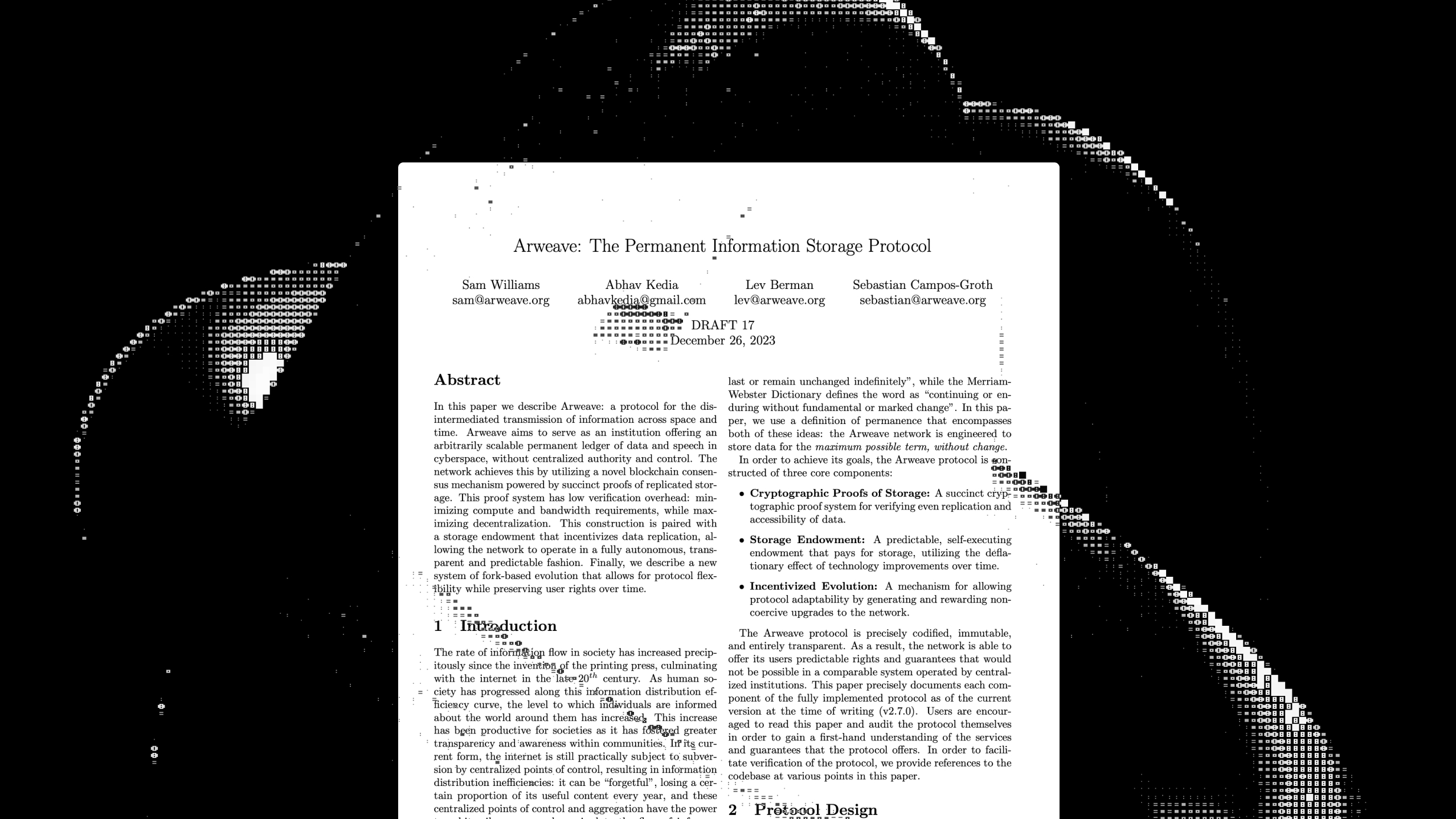
Arweave is a protocol primarily focused on the "flow" of information.
Information in the current age is "forgetful". Link rot, content drift, and intentional censorship of information means every year, valuable content on the internet is lost.
Centralized points of control are what restrict the flow of information. Arweave provides a decentralized, storage protocol to allow anyone to publish freely to better society, as well as storing it permanently to benefit future society to come.
Permanent Storage - How is it possible?
Permanence on Arweave is defined as storing "data for the maximum possible term, without change". It achieves this through:
- Cryptographic proofs
- A sustainable storage endowment
- Incentivized evolution of the protocol
Let's take a look at the protocol design and break down these three aspects forming permanent storage.
Protocol Design - Bitcoin, But For Data
Arweave is built from the ground up with data as the core emphasis.
The efficiency of mining and Arweave's consensus mechanism are designed for data, rather than an afterthought. This is how Arweave achieves such reasonable pricing for storage compared to other blockchains.
Arweave is inspired by Bitcoin's proof-of-work mechanism. A decentralized group of nodes collectively store data uploaded by users to Arweave, paid for with a one-time, upfront fee.
The majority of this goes into an endowment fund, which we'll cover soon.
Like Bitcoin and other blockchain networks, nodes mine and add new blocks - and on Arweave these blocks can contain data or wallet-to-wallet transactions (or both).
Nodes can choose data they would like to replicate from confirmed blocks - and are incentivized to replicate as much data as possible.
This happens through Arweave's unique consensus mechanism: Proof of Access (PoA).
Cryptographic Proofs (of Access)
Instead of solving a computationally expensive puzzle, to add a block to Arweave miners must prove (cryptographically) they have access to a random piece of previous data on Arweave.
This incentivizes nodes to store as much of the dataset as they can, as the more data they have stored, the better their chances to receive a block reward.
Alternatively, it also opens up opportunities for nodes who can't store the entire dataset to pool their data together and split the block rewards - similar to mining pools on Bitcoin (except based on data rather than computing power).
The technical name for this whole process is Succinct Proofs of Random Access (SPoRA). There's a ton more about how the cryptography behind it all actually works in the whitepaper.
Regardless, this first part of securing permanent storage is the consensus mechanism. Cryptographic proofs "prove" that data is being stored, and incentivizes replications. More replications contribute to data permanence on Arweave.
Keep reading to learn how the one-time fee for transactions makes permanent storage possible at the protocol level.
The Endowment
As mentioned earlier in the post, a user pays a one-time fee to upload data. There's two parts to this:
- Where does the fee go?
- How is the fee calculated?
Both of these are important in understanding how Arweave can offer permanent storage.
Let's start with the fee calculation.
The fee a user pays to store data upfront is to cover 20 replicas of their data for 200 years. Keep in mind both of these numbers are the minimum - it's likely much higher.
So how do you calculate the fee for 20 replicas and 200 years?
Arweave makes a conservative estimate on the cost to store the data presently - taking into account the current cost for storage in the network, block rewards, the size of the data, and then multiplying this by 20 (replications) and 200 (years). The majority of the fee, however, does not go to the miners - it goes into the endowment fund.
The endowment fund holds this $AR until when/if it becomes unprofitable to mine, which will then be released to miners. As of right now, the endowment fund contains ~70,000 $AR and is yet to be utilized - and is likely to last much longer than 200 years.
The endowment health is measured with something called the Kryder+ rate, which very conservatively estimates the declining cost of storage, electricity, and operational costs over time.
As these costs decline, it lengthens the time mining will stay profitable before the endowment needs to be utilized.
Not to mention, the cost of paying for the present cost of storage requires only a 0.5% decrease in the Kryder+ rate each year to continue sustaining the endowment - but the decrease has been an average of ~38.5% each year.
This conservative estimate allows fluctuations in the value of $AR, and by taking $AR out of circulation (by transferring it to the endowment) it increases the purchasing power of available tokens.
This endowment mechanism is what makes Arweave truly unique. It's what powers the fact you can pay once, and know your data will be stored for a minimum of 200 years with 20 replicas across the network - no perpetual contracts, or monopolies on your data.
Content Policies
One of the concerns around permanent storage is censorship and illicit content.
How do you ensure that a permanent information system is both censorship-resistant, but also doesn't become a home for illicit content?
This is a very hard balance to strike - Arweave has mechanisms in place to ensure that the network is self-moderated and not under centralized control.
Miners store data and content, gateways index and serve it, and application developers build on top of both.
On Arweave, each miner, gateway, and developer has their own choice on which content they would like to store/serve.
Miners can use tools to analyze data uploaded and decide whether or not they want to replicate it - meaning they can choose not to store data if it is illegal in their country.
Likewise, gateways can decide what data they want to serve to others. Even if it's mined to the network, it can be moderated at the gateway level. Users can then use the gateways to access data which aligns with them the most.
The last place for moderation is on the application level. DApp developers can moderate content that has been both mined and served and decide to moderate it - e.g. not showing NSFW content, or something similar.
It's up to the users of Arweave to choose which miners and gateways conform to their beliefs, and support those accordingly. There are nodes all over the world, so different countries or regions may have different laws or regulations in place.
Miners are de-incentivized from storing illegal or illicit content, and also morally objectionable content as other nodes on the network may refuse to share data with them or gateways may refuse to serve their content.
Decentralization means there is no central entity governing content; it's up to each node, gateway, developer, and individual to moderate content according to their preferences.
Incentivized Evolution
Remember Arweave's definition of permanence is to "store data for the maximum possible term, without change".
The last aspect of this is incentivized evolution of the Arweave protocol.
Arweave has put together a framework to encourage developers to create innovative forks of Arweave.
This framework is a purely social agreement, and it aligns incentives with those looking to create an alternative to Arweave. Any developers looking to fork Arweave should pick a base version of the protocol to begin with, and add any new features or changes they want.
They can then mint a quantity of tokens they deem reasonable to distribute (for profit, to investors, for the community) as a reward for creating a new mutation of the Arweave protocol. Some of the major points of the framework are to:
- Use the existing dataset
- Transfer any existing balances to users on the forked protocol
Which they are incentivized to do in order to encourage users to adopt the new protocol. Ultimately, it will be up to the community to decide if they want to support a fork or stick to the main protocol. The encouragement of forking adds a whole new layer of life to Arweave's potential multi-century existence. Read DRAFT 17 in its entirety here: