The Core Problem: Proving Storage
How do you verify that someone is actually storing your data? Not just claiming to store it. Not storing a compressed version. Not storing it today and deleting it tomorrow. Actually storing the full dataset, indefinitely, and able to prove it on demand.
This is the fundamental challenge of any decentralized storage network. Bitcoin solved it for financial records with Proof of Work. Arweave solves it for arbitrary data with Succinct Proof of Random Access (SPoRA).
How SPoRA Works
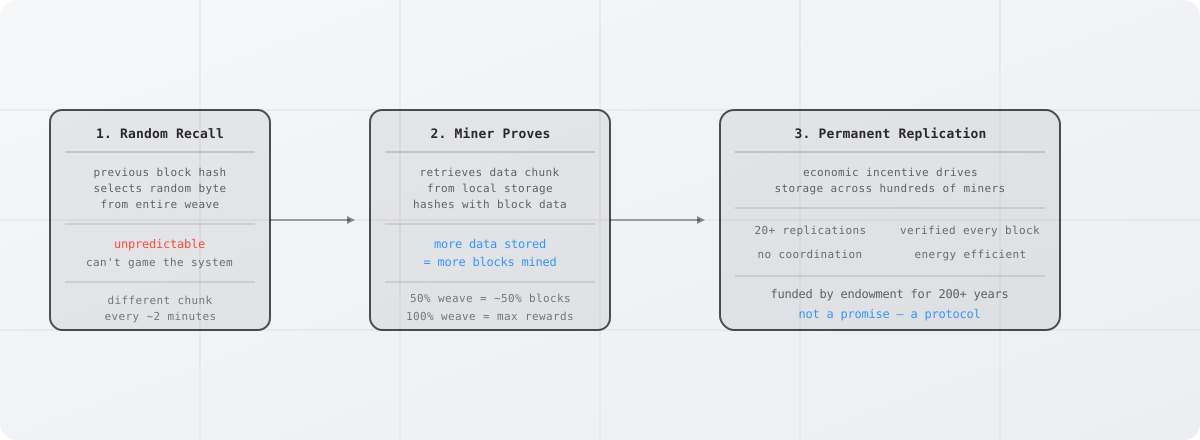
To mine a new block on Arweave, a miner must prove they have access to a randomly selected chunk of data from the entire history of the blockweave.
The process works like this:
- A random recall byte is generated. The network uses the previous block's hash to deterministically select a random byte offset within the entire weave (all data ever stored on Arweave)
- The miner must produce the chunk. The miner looks up which data chunk contains that byte offset and retrieves it from their local storage
- The chunk is hashed together with the candidate block. This creates a proof that the miner had the data at the time of mining
- The proof is verified by other nodes. Anyone can check that the chunk matches the recall byte and the hash is valid
This happens every block. A different random chunk is selected each time. There is no way to predict which chunk will be needed next.
Why Random Access Matters
The randomness is critical. If miners could predict which data would be needed, they could store only that subset. SPoRA makes this impossible:
- You can't know what will be asked for. The recall byte is derived from the previous block's hash, which is unpredictable until the block is mined
- You need the actual data. A hash or fingerprint of the chunk is not enough. The miner must produce the chunk itself
- More data = more chances. The more of the weave a miner stores, the more frequently they can respond to random recall challenges
This creates a direct economic incentive: miners who store more data mine more blocks and earn more rewards. No coordination required. No staking contracts. No centralized verification. The protocol itself ensures data replication through pure economic self-interest.
Comparison to Other Approaches
| Mechanism | Network | How It Works | Weakness |
|---|---|---|---|
| Proof of Work | Bitcoin | Hash puzzles, no data requirement | Doesn't prove data storage |
| Proof of Stake | Ethereum | Lock tokens as collateral | Doesn't prove data storage |
| Proof of Spacetime | Filecoin | Periodic proofs of storage sectors | Complex, time-limited contracts |
| SPoRA | Arweave | Random chunk recall each block | Requires storing full weave for max returns |
Filecoin's approach is the closest comparison. Filecoin miners prove they store specific sectors of data for the duration of a deal contract. When the deal expires, the data may not be re-stored. Arweave's approach is permanent by design: there is no contract expiration, and the endowment ensures miners are compensated indefinitely.
The Economics of Replication
SPoRA doesn't just incentivize storage; it incentivizes replication. Consider a miner's decision:
- Storing 50% of the weave means responding to roughly 50% of recall challenges
- Storing 90% means responding to roughly 90%
- Storing 100% means never missing a mining opportunity
The marginal cost of storing additional data decreases over time (storage gets cheaper every year), while the marginal revenue of storing more data remains proportional. This means the economically rational strategy is to store as much of the weave as possible.
The result: Arweave data is not stored once. It's replicated across hundreds of independent miners worldwide, each independently motivated to maintain complete copies of the dataset. This is how Arweave achieves 20+ replications of every piece of data without any central coordination.
The Blockweave Structure
SPoRA is tightly integrated with Arweave's unique data structure: the blockweave. Unlike a traditional blockchain where each block links only to the previous block, each Arweave block links to both:
- The previous block (like any blockchain)
- A randomly recalled older block (chosen by the recall byte mechanism)
This structure means miners must maintain access to the full history of the weave, not just recent blocks. Pruning old data would mean missing recall opportunities and losing mining revenue.
Packing and Mining Efficiency
Miners don't store raw data. They "pack" data chunks using a computationally intensive process that creates a unique encrypted version tied to their mining address. This has several effects:
- No outsourcing. A miner can't quickly download a needed chunk from another miner during the brief window of a recall challenge. The data must be pre-packed and locally stored.
- Fair competition. The packing process is calibrated so that mining is I/O-bound (limited by disk read speed), not CPU-bound. This means consumer hardware can compete with specialized mining rigs.
- Energy efficiency. Unlike Bitcoin's Proof of Work, SPoRA's computational cost is in the one-time packing process, not in ongoing hash puzzles. Mining itself is primarily a disk read operation.
What This Means for Your Data
When you upload data to Arweave, SPoRA guarantees that:
- Miners are economically incentivized to store it. The more they store, the more they earn
- Your data is replicated many times, across independent operators on different continents
- Replication is verified every block. Not once a month, not once a year. Every two minutes.
- No single party can delete it. Your data exists in hundreds of independent copies, each maintained by a different economic actor
Combined with the storage endowment that funds these incentives for 200+ years, and the gateway network that makes data accessible, SPoRA is the mechanism that makes Arweave's permanence guarantee concrete rather than theoretical.
It's not a promise. It's a protocol.