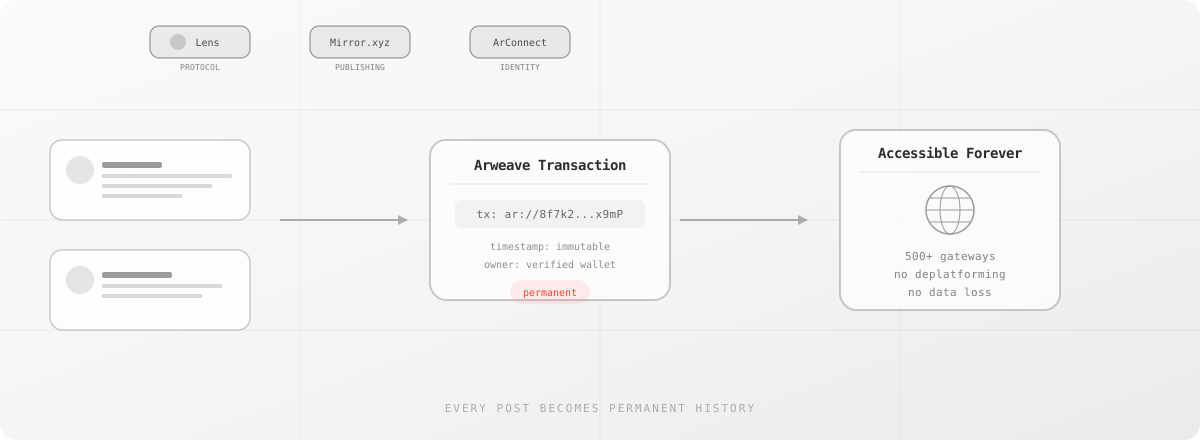
Social Media On Your Terms
On traditional platforms, your posts exist at the pleasure of the company that runs them. Twitter/X can suspend your account. Facebook can remove your content. Instagram can shadow-ban your reach. The platform owns the infrastructure, so the platform decides what stays and what goes.
Arweave flips this entirely. When a social post is stored as an Arweave transaction, it becomes permanent, uncensorable, and owned by the person who created it. No algorithm can bury it. No moderation team can erase it. No corporate acquisition can shut it down.
How It Works
Every social post on Arweave is a transaction with descriptive tags. A typical post might carry tags like:
Content-Type: text/plainApp-Name: lens-postAuthor-Wallet: 0x...Timestamp: 1706140800
These tags make every post searchable through gateway GraphQL APIs. Any client application can query, display, and organize posts without depending on a single backend server.
Platforms Building on Arweave
Several social platforms use Arweave as their permanent storage layer:
| Platform | What It Does | Arweave Role |
|---|---|---|
| Lens Protocol | Decentralized social graph on Polygon | Stores post content and metadata permanently on Arweave |
| Mirror.xyz | Long-form Web3 publishing | Every article is an Arweave transaction, readable forever |
| Wander (formerly ArConnect) | Arweave-native wallet and social | Social features built directly on the permaweb |
| Chatter | Decentralized messaging | Messages stored as permanent Arweave data items |
Lens Protocol is particularly notable. With over 100,000 profiles, Lens stores post content on Arweave through bundling services, ensuring that every publication, comment, and mirror exists permanently regardless of what happens to the Lens frontend.
Mirror: Publishing That Outlives the Publisher
Mirror.xyz treats Arweave as its source of truth. When a writer publishes an article on Mirror, the full content is written to Arweave as a transaction. Even if Mirror shuts down tomorrow, every article ever published on the platform remains accessible through any Arweave gateway.
This is the difference between posting on Medium (where the company controls your content) and publishing on Mirror (where the blockweave preserves it permanently).
The Contrast with Centralized Social Media
Consider what happens when a centralized platform disappears or changes policy:
- Vine: Shut down in 2017. Years of creative work, gone.
- Google+: Shut down in 2019. All user content deleted.
- Twitter/X post deletions: Accounts suspended, threads erased, no recourse.
- Facebook content moderation: Automated removals with limited appeal options.
On Arweave, none of this applies. A post stored as a transaction in 2024 will be readable in 2044. The storage endowment ensures miners are paid to keep serving that data for decades.
Why Permanence Matters for Social Data
Social posts are more than casual messages. They form a historical record: of movements, of public discourse, of cultural moments. The ability to retroactively delete or alter that record is a power that no single entity should hold.
Arweave's censorship-resistant architecture ensures that social content, once published, belongs to history. Not to a platform. Not to a government. To everyone.
Building a Social App on Arweave
Developers can build social applications on Arweave using the same pattern: write posts as tagged data items through the Turbo bundler, then query them back via GraphQL. Posts under 500 KB are free to upload through Turbo. The result is a social application with no hosting costs, no database to maintain, and no content that can ever be removed.
The permanent data layer that powers NFTs and DeFi frontends works just as well for social media. The only difference is what you store.