The Actor-Oriented Computer
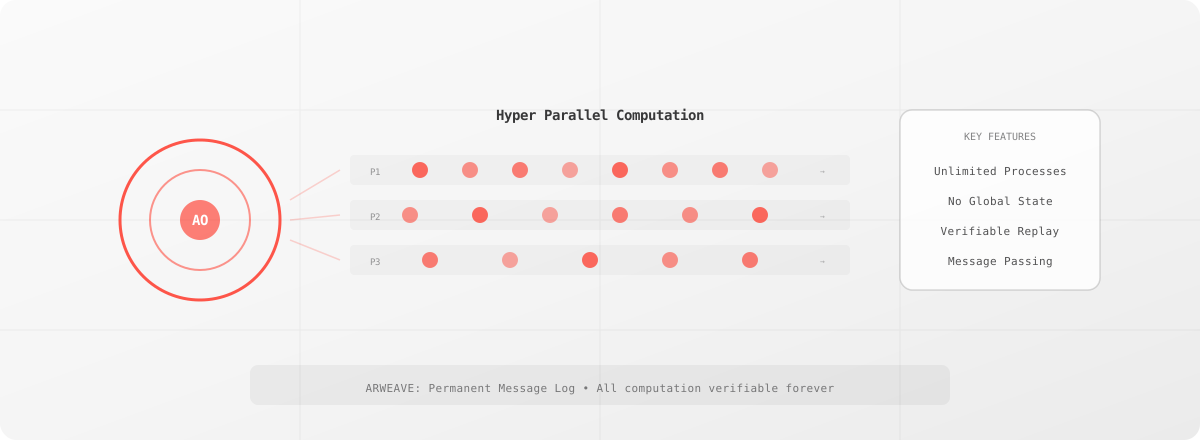
AO represents a fundamental rethinking of how decentralized computation works. While traditional blockchains process transactions sequentially through global consensus, AO enables unlimited parallel processes that communicate through messages stored permanently on Arweave.
The name comes from its Actor Oriented architecture, inspired by Carl Hewitt's actor model from 1973. Each process is an independent actor with its own state, timeline, and computation, interacting with others purely through asynchronous message passing.
Why It Exists
Every blockchain eventually hits a throughput ceiling. Ethereum processes roughly 15 transactions per second. Solana claims thousands but shares a global state that creates bottlenecks. The fundamental problem: they're all single computers trying to do everything at once.
AO sidesteps this entirely. There's no global state to synchronize. No consensus bottleneck. Each process runs independently, with its complete history permanently stored on Arweave. Verification happens by replaying messages from the immutable log: same inputs, same code, same result.
The Architecture
AO consists of three types of units working together:
Scheduler Units (SU) assign ordering to messages. When a process receives a message, a scheduler determines its position in the sequence. This ordering gets written permanently to Arweave.
Compute Units (CU) execute the actual computation. Given a process's message history, a compute unit runs the code and produces results. Anyone can run a compute unit and verify independently.
Messenger Units (MU) relay messages between processes. They're the communication layer that connects everything.
The result: a modular system where users can choose their virtual machines, sequencing trade-offs, and security guarantees. Everything settles onto Arweave's permanent data layer.
Real Applications
People are building real things on AO:
Autonomous agents that run continuously, making decisions and executing strategies without human intervention. AI systems that own assets and operate independently.
Permaweb applications where both frontend and backend run decentralized. Full-stack apps with no servers anywhere.
Decentralized exchanges where matching engines run as processes, handling concurrent orders without bottlenecks.
Games with persistent worlds where player actions become permanent messages, creating truly persistent game states.
Arweave + AO = Full Stack Decentralization
Here's how they work together:
- Arweave is the hard drive: permanent, decentralized storage for all data and messages
- AO is the computer: parallel processes using Arweave as permanent memory
This is what the permaweb was building toward: not just permanent storage, but permanent computation. Data that lives forever, running code that lives forever.
Getting Started
Explore AO at ao.arweave.dev or browse messages at aolink.arweave.net.
Developers can start with the AO Cookbook for tutorials on building processes, sending messages, and deploying applications.