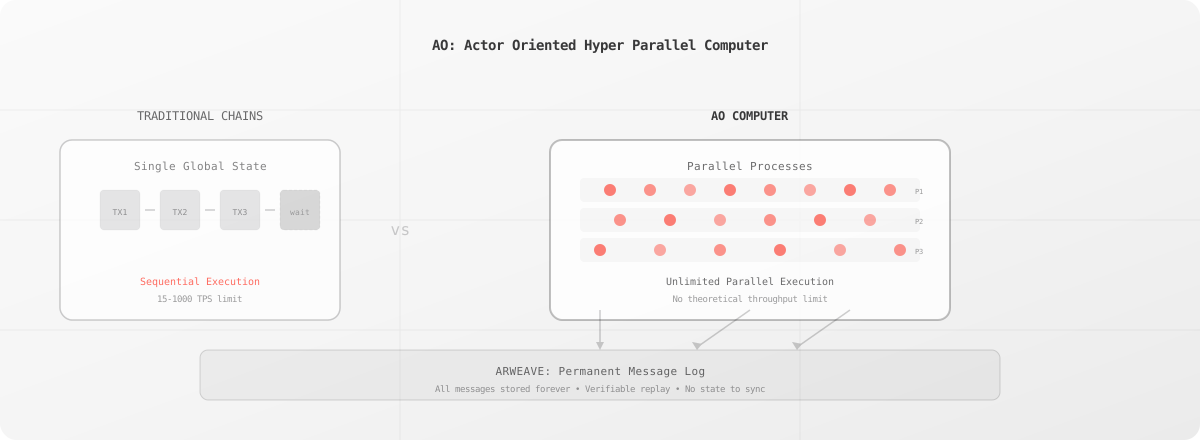
The Hyper Parallel Computer
AO is the actor oriented machine that emerges from the network of nodes that adhere to its core data protocol, running on the Arweave network. The name comes from its Actor Oriented design, where computation happens through independent processes that communicate via messages.
Here's the core insight: traditional blockchains are single-threaded. Ethereum processes about 15 transactions per second. Solana claims thousands but still has a global state that creates bottlenecks. Every chain eventually hits a wall because they all share the same architecture: one computer, one sequence of operations, everyone fighting for space in the same block.
AO doesn't have that limitation. It's a single, unified computing environment hosted on a heterogeneous set of nodes, designed to offer an environment in which an arbitrary number of parallel processes can be resident, coordinating through an open message passing layer.
How It Actually Works
The message passing standard connects independently operating processes together into a "web," the same way that websites operate on independent servers but are conjoined into a cohesive experience via hyperlinks.
Each process in AO:
- Runs independently on its own timeline
- Maintains its own state derived from its message history
- Communicates via messages that get permanently stored on Arweave
- Can be verified by anyone by replaying messages from the log
There's no global state to synchronize. No consensus bottleneck. When you want to verify what a process did, you download its messages from Arweave and replay them yourself. Same inputs, same code, same result.
The Three Core Units
AO's architecture consists of three types of units that work together:
Scheduler Units (SU) assign ordering to messages. When a process receives a message, a scheduler determines where it fits in the sequence. This ordering gets written permanently to Arweave.
Compute Units (CU) execute the actual computation. Given a process's message history, a compute unit runs the code and produces the result. Anyone can run a compute unit and verify results independently.
Messenger Units (MU) relay messages between processes. They're the communication layer that connects everything together.
The beauty is modularity: users can choose which virtual machines, sequencing trade-offs, message passing security guarantees, and payment options work best for them. Everything eventually settles onto Arweave's permanent data layer.
Why Arweave Makes This Possible
AO couldn't exist without Arweave. Traditional blockchains need consensus on a single global state. That's what limits them.
AO has no global state to synchronize. Each process maintains its own state, computed from its permanent message log. Arweave provides that log: a content-addressed storage layer that anyone can read, that nobody can modify, and that persists indefinitely.
When you write a message to an AO process, it becomes an Arweave transaction. That message exists forever. The complete history of every process is permanently auditable. State isn't stored; it's computed on demand from the immutable record.
This is what makes trustless verification possible: you don't need to trust anyone's claim about what a process did. You can check it yourself.
Real Applications
People are building real things on AO:
Autonomous agents that run continuously, making decisions and executing strategies without human intervention. AI systems that actually own assets and operate independently.
Permaweb applications where the frontend deploys to Arweave and the backend logic runs as AO processes. Full-stack decentralized apps with no servers anywhere.
Decentralized exchanges where matching engines run as processes, handling thousands of concurrent orders without bottlenecks.
Games with persistent worlds where thousands of players interact through message-passing, each action permanently recorded.
The Numbers
AO went live on mainnet in February 2025 after a year-long public testnet. The architecture has processed billions of messages, with activity accelerating as more applications deploy.
For context: Arweave itself has surpassed 23.5 billion transactions total, with roughly 8 million transactions per day flowing through the network. A significant portion of that is now AO message traffic.
Comparison: Monolithic vs. Hyper-Parallel
| Aspect | Monolithic Chains | AO |
|---|---|---|
| Architecture | Single global state | Unlimited parallel processes |
| Throughput | Limited by consensus | No theoretical limit |
| State | Validators must sync entire state | Each process computes from its own log |
| Computation | Bounded by gas/block | Unbounded per process |
| Verification | Trust validators | Replay from Arweave |
| Failure mode | Chain halt affects everyone | Individual process only |
Why This Matters
Most "scaling solutions" are band-aids: rollups, sharding, Layer 2s. They add complexity while keeping the same fundamental architecture. Eventually, you hit the same walls.
AO is architecturally different. It doesn't try to make a single blockchain faster. It reframes the problem entirely: instead of consensus on state, you get consensus on messages, stored permanently on Arweave, replayable by anyone, verified without trust.
The result is a compute layer with no inherent throughput limits, backed by permanent storage that guarantees every computation can be verified forever.
Arweave + AO = The Full Stack
Here's how they work together:
- Arweave is the hard drive: permanent, decentralized storage for all data and messages
- AO is the computer: parallel processes that use Arweave as their permanent memory
You can store files on Arweave. You can deploy websites to the permaweb. You can write applications as AO processes. All on the same underlying infrastructure, all permanent, all decentralized.
This is what the permaweb was building toward: not just permanent storage, but permanent computation. Data that lives forever, running code that lives forever.
Getting Started
Explore AO at ao.arweave.net or dive into the message explorer at aolink.arweave.net.
Developers can start with the AO Cookbook for tutorials on building processes, sending messages, and deploying applications. The official spec lives at ao.arweave.dev.
The combination of permanent storage and hyper-parallel compute is genuinely novel. Most ideas in crypto are iterations on existing concepts. AO is something different.