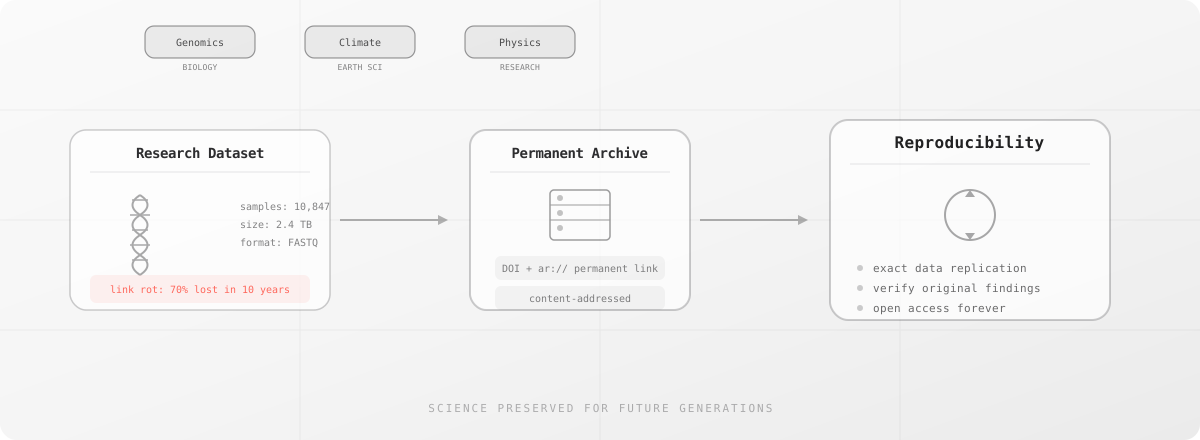
The Reproducibility Crisis
Science depends on verification. A result is only valid if other researchers can reproduce it. But reproducing an experiment requires access to the original data, and that data is disappearing at an alarming rate.
A 2014 study published in Current Biology found that the availability of research data drops by 17% per year after publication. After 20 years, most datasets are effectively gone. The URLs in published papers break. The servers hosting supplementary materials go offline. The hard drives holding raw results fail.
This is not a hypothetical problem. It is actively undermining the foundation of scientific progress.
Why Existing Storage Falls Short
Researchers typically store data on university servers, personal drives, or cloud services. Each of these has a critical weakness:
| Storage Method | Failure Mode |
|---|---|
| University servers | Decommissioned when grants end or departments reorganize |
| Personal hard drives | Hardware failure, lost in moves, inaccessible after retirement |
| Cloud storage (AWS, Google) | Requires ongoing payment; data deleted when funding lapses |
| IPFS | Data persists only as long as someone actively pins it |
| Journal supplementary files | Hosted by publisher; URLs break during platform migrations |
The common thread: all of these require someone to keep paying and keep caring. When the grant runs out, the professor retires, or the journal changes its CMS, the data vanishes.
Arweave: Pay Once, Preserve Forever
Arweave's model is fundamentally different. A researcher uploads a dataset, pays a one-time fee, and the data is replicated across a decentralized network of miners. The storage endowment pays miners to serve that data for decades. No recurring costs. No dependency on any institution's continued existence.
Every dataset gets a permanent transaction ID that serves as a URL through any Arweave gateway:
https://arweave.net/<transaction-id>
That link will work in 2025. It will work in 2045. It will work as long as the Arweave network exists.
The DeSci Movement
Decentralized Science (DeSci) is a growing movement that applies blockchain principles to scientific research. The core ideas: open access to data, transparent peer review, and permanent preservation of results. Arweave fits naturally as the storage layer for DeSci because it guarantees that published data cannot be altered, deleted, or paywalled after the fact.
Projects in the DeSci space using or exploring permanent storage include:
- DeSci Labs: Building tools for open, reproducible research with permanent data storage
- Fleming Protocol: Decentralized biomedical data sharing
- GenomesDAO: Secure genomic data storage and monetization
- Open-access preprint archives: Storing papers permanently to bypass journal paywalls
What Kind of Data Belongs on Arweave
Scientific data comes in many forms, and Arweave can store all of them:
- Raw experimental results: Measurements, observations, sensor readings
- Gene sequencing data: Genomic datasets that need to be preserved and shared
- Climate records: Temperature readings, satellite imagery, environmental monitoring data
- Medical trial data: Patient outcomes, drug efficacy measurements (anonymized)
- Astronomical observations: Telescope data, spectral analyses, survey results
- Code and analysis scripts: The software used to analyze data, stored alongside the results
Storing the analysis code alongside the data is especially powerful. It means anyone can not only access the raw data but also run the exact same analysis pipeline the original researchers used.
IPFS vs. Arweave for Scientific Data
IPFS is often mentioned as a decentralized storage option for research, but there is a fundamental difference:
- IPFS stores data only as long as at least one node actively pins it. If no one is willing to run a node and pin your dataset, it disappears. There is no economic mechanism guaranteeing long-term persistence.
- Arweave pays miners through a protocol-level endowment to store data permanently. The incentive is built into the network itself, not dependent on voluntary participation.
For scientific data that needs to be available in 10, 20, or 50 years, this distinction is decisive.
Open Access Without Paywalls
Major scientific publishers charge $30 to $50 per article. This paywalling of publicly funded research has been controversial for decades. When scientific papers are stored on Arweave, they become permanently and freely accessible to anyone with an internet connection.
This aligns with mandates from funding agencies like the NIH and European Research Council, which increasingly require open access to publicly funded research. Arweave provides the infrastructure to make open access truly permanent, not dependent on a publisher's willingness to maintain a free tier.
Why This Matters
Science is humanity's best tool for understanding the world. But that tool only works if results can be verified, reproduced, and built upon. When the data behind scientific discoveries disappears, we lose the ability to check the work.
Permanent data storage on Arweave ensures that the datasets, papers, and analysis code behind scientific discoveries remain accessible indefinitely. The cost is minimal. The benefit to future researchers is immeasurable.