The Problem No One Was Solving
Data disappears. Not in dramatic, catastrophic events, but in the quiet, ordinary way that things on the internet always have. A startup shuts down and takes its users' files with it. A social platform changes its terms of service and purges old content. A government pressures a hosting provider to remove inconvenient archives. A hard drive fails and no one had a backup.
The internet was built for communication, not preservation. HTTP is stateless. DNS records expire. Servers are rented month to month. Every piece of data you've ever put online exists only because someone, somewhere, is still paying to keep it accessible.
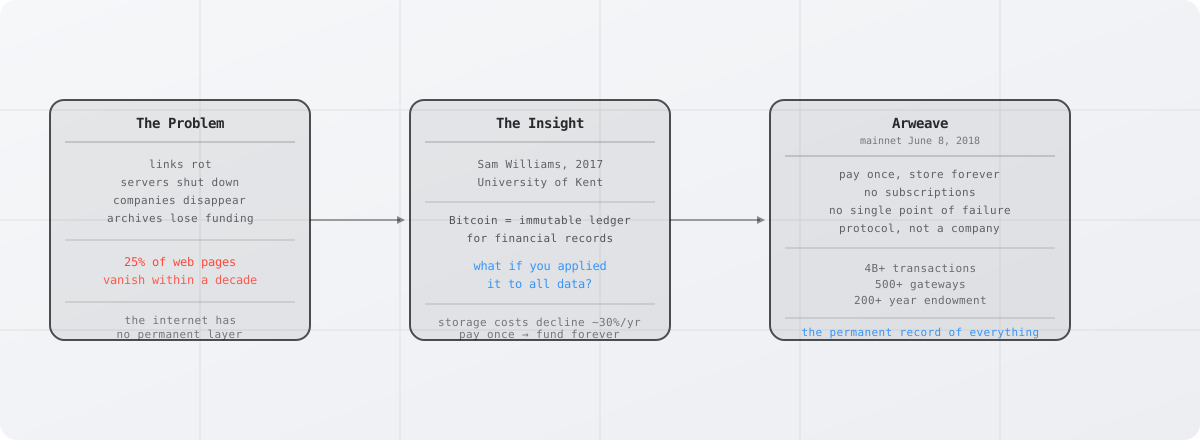
By 2017, this was not a theoretical concern. Link rot studies showed that roughly 25% of web pages from a decade earlier had vanished. Supreme Court citations to online sources were breaking. Entire digital archives were disappearing when the organizations maintaining them ran out of funding.
The internet had no permanent layer.
Sam Williams and the Insight
Sam Williams was a PhD student at the University of Kent, studying decentralized data protocols. His research focused on a specific question: could you build a data storage system with no single point of failure and no ongoing cost?
The timing mattered. Bitcoin had proven that a decentralized network could maintain an immutable, append-only ledger without any central authority. Ethereum had shown that you could extend the blockchain concept beyond financial transactions. But no one had applied these principles to the core problem of data storage.
Williams saw the opportunity clearly. Bitcoin's blockchain is permanent, but it only stores transaction records. What if you built a blockchain-like structure designed specifically for arbitrary data: images, documents, videos, applications, entire websites?
The key insight was economic. Permanent storage sounds impossible until you account for one of the most reliable trends in technology: the cost of storage declines roughly 30% per year. A gigabyte that costs pennies today cost dollars a decade ago and hundreds of dollars two decades before that.
If you charged users a one-time fee calculated against a conservative projection of this decline, you could fund storage not just for years, but for centuries.
From Archain to Arweave
Williams founded the project in 2017 under the name Archain. The concept attracted immediate interest from researchers and technologists who understood the permanence problem.
The project was renamed to Arweave, and the mainnet launched on June 8, 2018. From day one, the design was different from other blockchain projects:
- No recurring payments. You pay once when you upload. That's it.
- No token lockups or staking contracts. The protocol uses a storage endowment that automatically compensates miners over time.
- No company dependency. Arweave is a protocol. It runs on a decentralized network of miners and gateways. There is no server to shut down, no subscription to cancel, no company that needs to stay profitable.
- Data as a first-class citizen. While other chains optimized for computation, Arweave optimized for storage. The entire architecture, from the blockweave data structure to the Succinct Proof of Random Access (SPoRA) consensus mechanism, is designed around one goal: keeping data accessible forever.
The Opportunity
The internet generates an estimated 2.5 quintillion bytes of data per day. The vast majority of it is ephemeral, but a meaningful fraction has long-term value: scientific research, cultural works, journalism, legal records, open-source code, personal memories, historical documentation.
Today, all of this depends on continued human attention and payment. An archive survives only as long as someone renews the hosting. A photograph exists only as long as the cloud provider stays in business. A news article remains accessible only as long as the publisher maintains its servers.
Arweave offers something fundamentally different: a storage layer where data persists by default. Not because a company promises to keep it, but because the protocol's economic incentives make it more profitable to store data than to discard it.
This is not just a storage solution. It's an information commons. Knowledge, culture, science, journalism, code, all preserved without depending on any company's continued existence or anyone's willingness to keep paying monthly bills.
What Makes It Different
Other projects have attempted permanent or long-term storage. IPFS provides content-addressed storage but requires active pinning. Filecoin offers time-limited storage contracts. Traditional cloud providers offer durability guarantees that last exactly as long as you keep paying.
Arweave is the only protocol where permanence is the default, not an option. The endowment mechanism, the mining incentives, the blockweave architecture, all of it is designed so that data uploaded today will still be accessible in 100 or 200 years without any further action from anyone.
The network has been operating since June 2018. It has stored over 4 billion transactions. It serves data through hundreds of independent gateways worldwide. And the endowment that funds its permanence grows stronger every year as storage costs continue to decline.
The Vision
If Bitcoin is the permanent financial record, Arweave is the permanent record of everything else.
Williams built Arweave on the belief that information should not be fragile. That the sum of human knowledge should not depend on any single company, government, or individual continuing to pay a monthly bill. That once something is recorded, it should stay recorded.
That is the opportunity. Not just better storage, but a fundamentally different relationship between humanity and its data. One where the default is permanence, not deletion. Where preservation does not require ongoing attention. Where the record endures.